
The 4 Best Text To Speech (TTS) Software For News Sites
News publishers face a huge challenge: readers want content on their terms, and audio is no longer optional.
Audio keeps visitors on your site longer, opens new revenue streams through programmatic advertising, and reaches audiences who prefer to listen while commuting, exercising, or multitasking.
But the problem is that choosing the wrong text-to-speech platform means wasting time integrating the app, having poor audio quality, or getting pricing that eats into your margins.
So in this guide, we’ll compare four text-to-speech platforms built specifically for publishers who want to monetize their content. You’ll see exactly what each platform offers, what it costs, and which one matches your publishing workflow.
TLDR:
News publishers need audio versions of their articles, but choosing the wrong text-to-speech platform wastes time and money. So here are the four best TTS platforms we’ve found that are built specifically for publishers who want to monetize their content:
- Trinity Audio ($5.42/month) is your best choice if monetization is the priority. It offers embeddable audio players, programmatic advertising, display ad integration, and content discovery features that create multiple revenue streams from one article.
- ElevenLabs ($5/month) delivers highly realistic, emotionally aware voices in 30 languages. Great for publishers who want broadcast-quality audio and easy integration via Audio Native player.
- Google Cloud Text-to-Speech (pay-as-you-go at $4/1M characters) provides multiple AI models including WaveNet, Neural2, Chirp 3, and Gemini TTS. Best for high-volume publishers who need API flexibility and 300+ voices across 70+ languages.
- Murf AI ($19/month) offers 200+ voices, voice cloning, and strong customization through Murf Reader. Ideal for publishers who want a consistent branded voice but need to verify its automation fits their workflow.
The Bottom Line:
Your choice really depends on publishing volume, technical capabilities, and your revenue goals. High-volume sites need automated workflows and API integration. Smaller publishers will most likely prioritize voice quality and customization over automation.
Key Considerations for News Sites
- Voice naturalness & languages: Are the voices realistic enough for your audience? Do you need multiple languages or dialects?
- Integration into your website: Do you need a widget (play button next to each article)? Do you want downloadable MP3s? Do you have a CMS (WordPress, custom) that supports it?
- Cost & usage volume: News sites can generate high volumes of text; check pricing tiers (per character, per minute, flat subscription).
- Branding / consistency: Do you want an “in-house voice” (same narrator voice across all articles)? Some tools allow voice customization and cloning.
- Accessibility & compliance: Ensuring your site meets web accessibility standards (WCAG) might push you toward certain tools.
- Pronunciation/customization: In news content you often have proper names, places, slang; can the tool handle pronunciation corrections or custom lexicons?
- Latency / automation: If you publish many articles daily, you’ll want near-instant generation or a workflow that auto-creates audio when the article goes live.
- Analytics & usage tracking: Do you want to know how many users click “listen”, average listen time, etc.? Choose tools that provide analytics.
Comparison: The Best Text To Speech (TTS) Software For News Sites
The Best Text To Speech (TTS) Software For News Sites
Each platform below solves the same core problem (turning text into audio) but they approach it differently. Some excel at automated workflows for high-volume publishers while others prioritize voice quality or offer unique monetization features like embedded display ads.
Here’s an overview of what makes each platform worth considering for your news site.
1. Trinity Audio
.webp)
Trinity Audio is a content platform that converts text, such as news articles, blog posts, and reports, into natural-sounding audio. It provides tools for distribution and monetization to help businesses reach a wider audience and make their content accessible through a customizable audio player on their website.
Why It’s A Good Option For News Sites
Trinity Audio offers an embeddable audio player that uses AI and text-to-speech technology to automatically scan and convert news articles and blog posts into high-quality audio in over 125 languages. News publishers can add audio versions of their content to their websites through a simple, one-time integration.
You can select different voice styles, including a Newscaster voice powered by Amazon Polly’s Neural Text-to-Speech technology for professional, natural news narration. The feature works across all supported CMS platforms, including WordPress, Webflow, and Squarespace.
For monetization, Trinity Audio supports programmatic audio advertising with targeted ads before, during, or after playback. It also offers a display ad player that combines audio playback with banner display and customizable CTAs to boost revenue.
Additionally, Trinity Audio’s content discovery unit, Trinity Pulse, highlights a publisher’s most popular and trending audio content. And it allows them to create curated playlists of their favorite content or let the platform’s generate them to create a local, radio-like experience that keeps audiences engaged longer and increases revenue potential.
For wider reach, Trinity Splash offers modular distribution options that make it easy to share content across top streaming platforms such as Spotify, Apple Podcasts, and Google Podcasts, as well as through voice assistants like Alexa and Google Assistant.
2. ElevenLabs
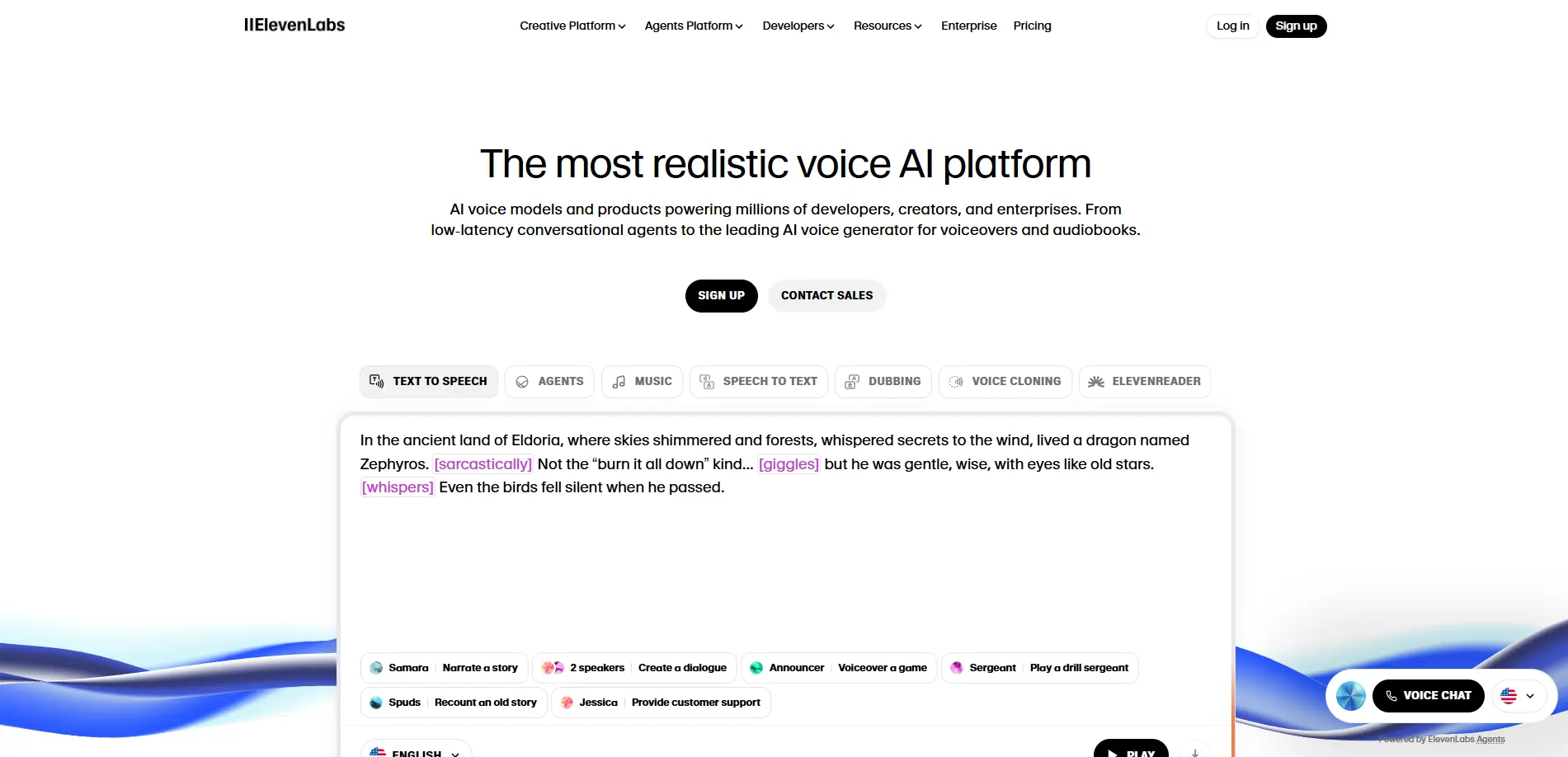
ElevenLabs is an audio research and product company that develops natural-sounding speech synthesis software using deep learning. It offers an AI voice generator and voice agents that produce lifelike, emotionally rich, and context-aware speech.
Why It’s A Good Option For News Sites
ElevenLabs offers its Multilingual v2 model to generate expressive, natural-sounding speech in nearly 30 languages. When text is inserted into the text-to-speech platform, it automatically detects the language and produces speech with exceptional authenticity. The speaker’s unique tone and accent are preserved across all supported languages.
The platform delivers lifelike narration with natural prosody and emotional depth, adjusting key parameters such as pitch, speed, and volume to ensure smooth and realistic news reading. This is ideal for publishers who want audio that feels professional, consistent, and engaging for their audiences.
ElevenLabs also offers Audio Native, an embedded player that can automatically voice written content on a webpage through a simple HTML snippet. It integrates easily with WordPress, Wix, Webflow, Ghost, and other major platforms to add audio versions of news articles directly to a site.
For publishers who want to distribute audio as podcasts, the generated MP3 files must be uploaded to a podcast hosting provider like Buzzsprout before embedding them back on the website. In that case, it’s important to consider the combined cost of ElevenLabs and the chosen podcast hosting service.
3. Google Cloud Text-to-Speech
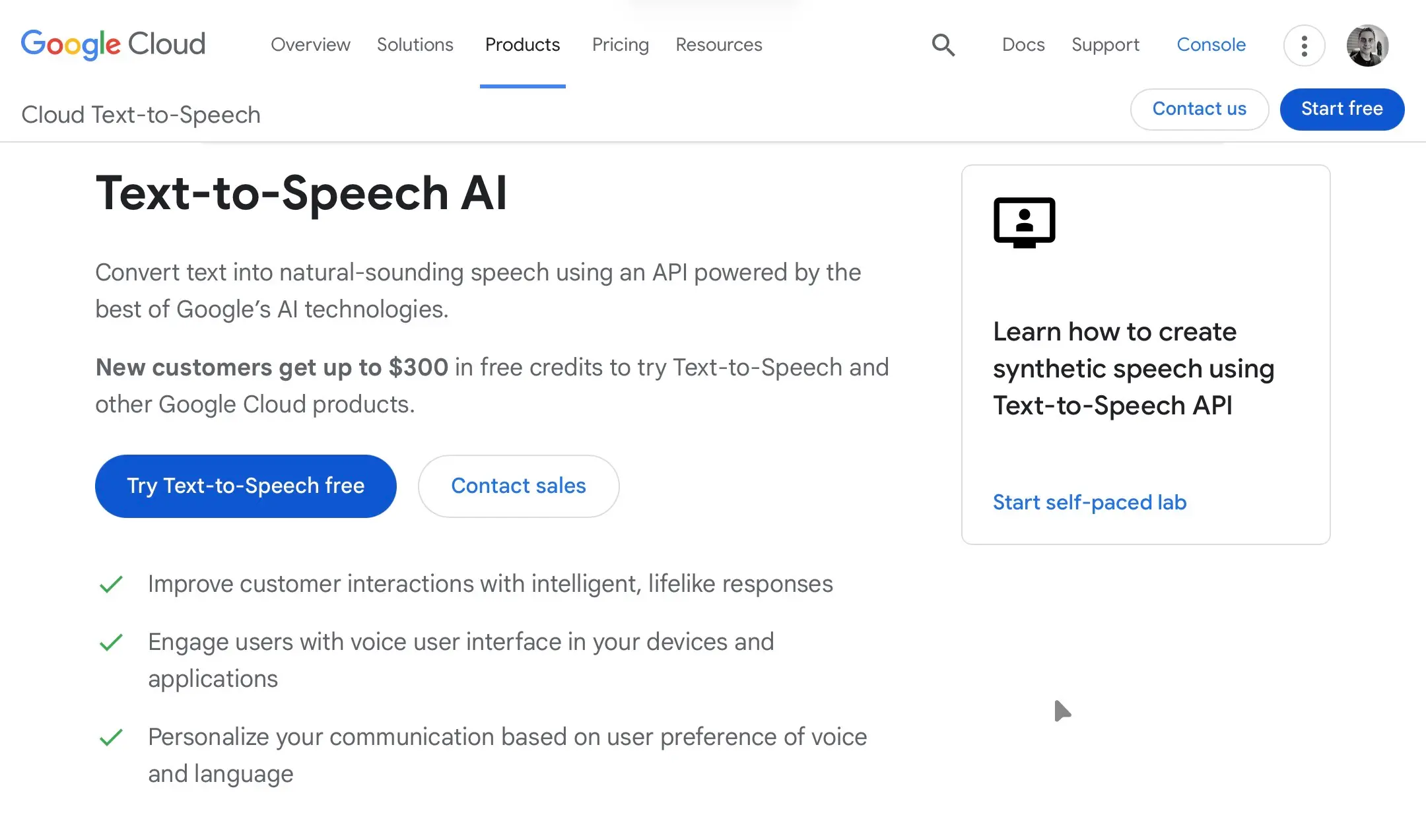
Google Cloud Text-to-Speech is an API that generates natural, human-like speech from written text. It allows you to turn blog posts and other written content into engaging audio experiences using advanced deep learning models. It helps save time, improve output quality, and deliver a more immersive listening experience.
Why It’s A Good Option For News Sites
Google Cloud Text-to-Speech offers numerous model options for news publishers. WaveNet and Neural2 produce realistic speech that matches the tone and pacing of news content. Both models offer an effective balance between quality and cost, which is ideal for large volumes of content.
Chirp 3 works well for premium audio experiences. It delivers clear, near-human speech with low latency, creating a broadcast-level listening experience that aligns well with professional news audio content.
Gemini TTS is another strong option for publishers looking for greater creative control. It allows fine-tuning of tone, emotion, pace, and accent to enable expressive narration across single or multi-speaker formats.
The platform leverages DeepMind’s speech synthesis expertise and offers more than 300 voices across 70+ languages. This helps publishers create a consistent brand voice across different touchpoints.
Implementation is straightforward. Publishers use the Google Cloud TTS API (via Python, Node.js, or command line) to send article text and specify an output format like MP3. The API returns Base64-encoded audio data, which is decoded, saved, and uploaded to a CDN or Google Cloud Storage for fast delivery, then embedded into website HTML using the standard <audio> tag.
4. Murf AI
.webp)
Murf AI is a text-to-speech platform and AI voice generator that turns written text into natural, high-quality audio. It provides voice cloning and a large library of realistic voices in multiple languages. It also includes customization tools to create polished audio that fits your brand and content.
Why It’s A Good Option For News Sites
Murf AI offers a lightweight audio solution for publishers through Murf Reader, which allows you to turn news articles and blog posts into audio with a simple script. You just need to copy the embed code, paste it into your CMS or HTML editor, publish, and the player appears in the bottom left of the page without replacing any content.
The script works well on platforms that accept small embed tags such as WordPress, Webflow, and custom frameworks. It behaves like any standard embed and stays lightweight for fast-loading news pages.
For voice customization, the platform supports more than 200 realistic voices in 35 languages and over 10 accents, with controls to adjust pitch, pronunciation, and narration speed, which helps news sites match narration style to their publication’s tone.
The platform also includes AI voice cloning that prioritizes naturalness and human-like intonation, making it well suited for ads, audiobooks, professional narration, and branded audio experiences.
The voice quality is strong and valuable if you want a consistent “voice” across your site, though the platform leans more toward voice-over and creative production than automated article reading. Check that its automation capabilities align with your publishing workflow before committing.
Conclusion
The right text-to-speech platform does three things for your news site: it converts content efficiently, delivers audio your audience wants to hear, and generates measurable revenue. With that in mind, consider the following:
- Trinity Audio is the best choice if monetization drives your decision. Its programmatic advertising integration and display ad audio player create multiple revenue streams from a single piece of content.
- ElevenLabs and Google Cloud Text-to-Speech offer exceptional voice quality when your priority is broadcast-level narration.
- Murf AI provides a middle-ground solution with strong customization for publishers who need brand-consistent voices across their content.
That said, your choice will depend on your publishing volume, technical capabilities, and revenue goals.
High-volume news sites publishing dozens of articles daily need automated workflows and API integration. Smaller publishers or those focused on premium audio experiences might prioritize voice quality and customization over automation.
So go ahead and calculate your monthly volume, review each platform’s pricing tier, and test the voice quality with your actual content before committing.

.png)